
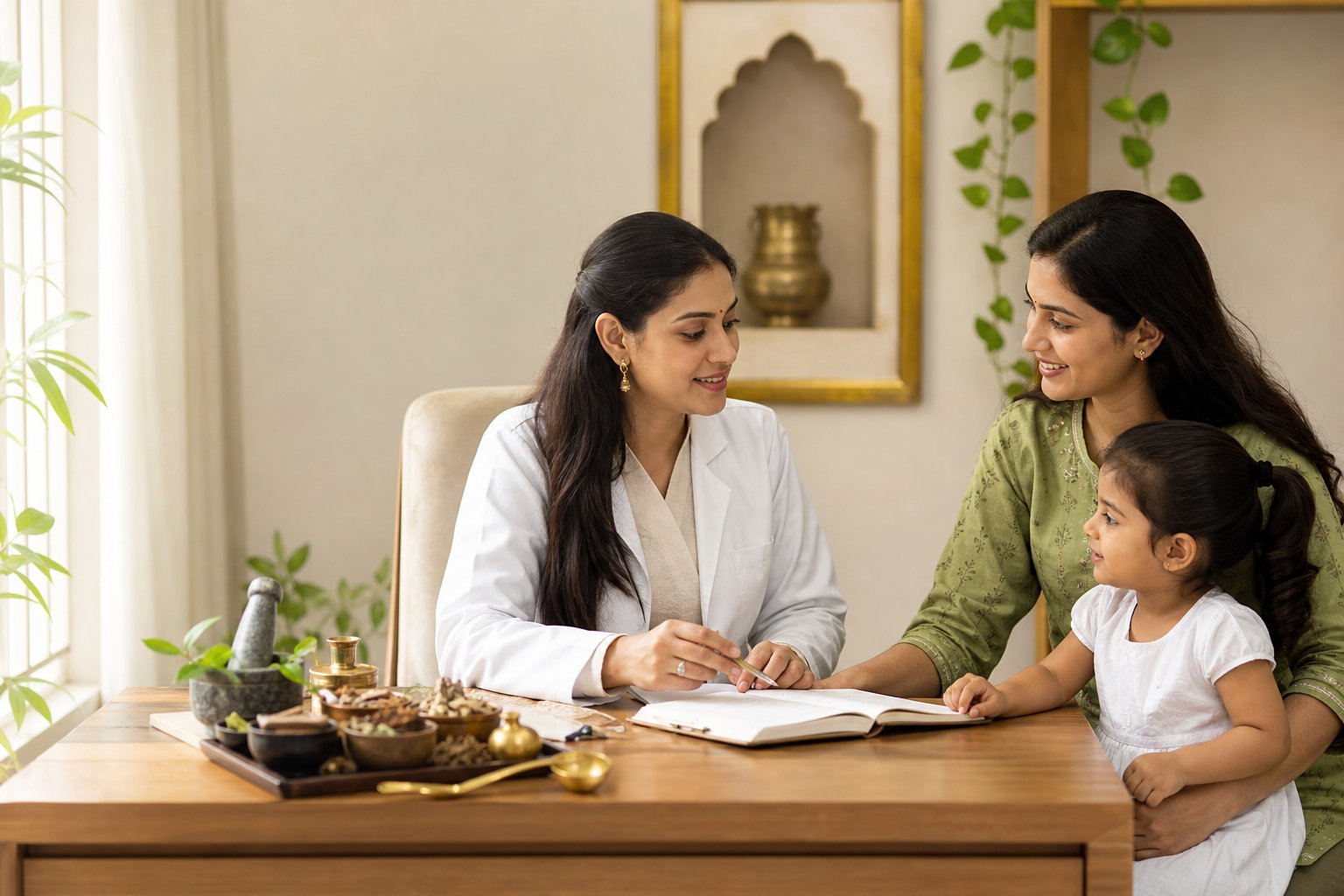
If you have been typing “PCOD ka ilaj” or “irregular periods treatment” into your phone late at night, this article is for you. Perhaps your period has not come for two or three months, the weighing scale keeps creeping up even though you eat less than everyone at home, and stubborn acne and hair fall have made you dread mirrors. Perhaps a doctor has already handed you a strip of hormonal pills and said, “Take these, your period will come.”
Take a breath. PCOS — Polycystic Ovarian Syndrome, commonly called PCOD (पीसीओडी) — affects roughly one in five young Indian women. It is not your fault, and it is not something you simply have to live with.
I am Dr. Akanksha Srivastava, and at Shree Vishwshraddha Chikitshalaya in Prayagraj I have treated more than 500 women with PCOS. In this guide I will explain what PCOS actually is, why pills alone rarely solve it, and the step-by-step Ayurvedic protocol that has helped so many of my patients get their cycles — and their confidence — back.
What Is PCOS (PCOD) and How Do I Know I Have It?
PCOS is a hormonal and metabolic imbalance in which the ovaries produce excess androgens (male-type hormones) and ovulation becomes irregular or stops altogether. On ultrasound the ovaries may show multiple small immature follicles — the “cysts” in the name — although not every woman with PCOS shows them, and not every woman with cysts has PCOS.
The signs my patients most often describe are:
- Irregular, delayed or missed periods (aniyamit mahavari / अनियमित माहवारी)
- Weight gain, especially around the belly, that refuses to budge
- Acne along the jawline and oily skin, well past teenage years
- Excess facial or body hair, while scalp hair thins
- Dark, velvety patches on the neck or underarms
- Difficulty conceiving
- Mood swings, low energy and disturbed sleep
You do not need every symptom. Even two or three of these, alongside irregular cycles, deserve a proper evaluation with an ultrasound and hormone tests. Our quick symptom checker can help you decide whether a consultation makes sense.
What Actually Causes PCOS?
At the centre of most PCOS is insulin resistance — the body’s cells stop responding properly to insulin, so the pancreas makes more of it, and that excess insulin pushes the ovaries to make more androgens. Genetics load the gun; a sedentary routine, refined-carbohydrate diet, chronic stress and poor sleep pull the trigger.
Ayurveda described this pattern centuries ago: aggravated Kapha blocking the Artava Vaha Srotas (reproductive channels) with disturbed Vata, so ovulation loses its rhythm. Both descriptions agree on the encouraging part — PCOS is largely a lifestyle-metabolic disorder, and it responds remarkably well to root-cause treatment.
Why Hormonal Pills Alone Often Are Not Enough
Birth-control pills have a legitimate place — they protect the uterine lining and control heavy bleeding. But understand what they do and do not do. The monthly bleed on the pill is a withdrawal bleed, not proof that your ovaries have started ovulating. The pill does not touch insulin resistance, weight, androgen excess at its source, or fertility — which is why the old irregularity so often returns the moment the pill stops, sometimes worse.
If your goal is a cycle that runs on its own and the option of conceiving naturally, the imbalance underneath has to be corrected — exactly what our PCOS treatment protocol is designed to do.
How We Treat PCOS at Shree Vishwshraddha Chikitshalaya
There is no single “PCOS medicine” in Ayurveda, because no two women’s PCOS is identical. After assessing your Prakriti (constitution), reports and history, we build a personalised plan that usually combines:
- Panchakarma therapy: supervised cleansing procedures such as Virechana and medicated Basti to clear the Kapha blockage, improve metabolism and restore Vata’s rhythm.
- Uttarbasti, where appropriate: a specialised procedure in which medicated oil or ghee is administered through the uterine route, particularly useful when ovulation or the uterine environment needs direct support.
- Vrishya Chikitsa: reproductive-strengthening therapy for women planning pregnancy.
- Classical herbs: formulations built around Shatavari, Ashoka and other time-tested herbs, selected and dosed for your specific pattern — never a one-size-fits-all bottle.
Progress is tracked the honest way: cycle dates, weight, skin, follicular scans where needed. In our clinic’s experience, most women who follow the full protocol see their cycles begin to regularise within three to six months.
Diet and Lifestyle That Actually Move the Needle
Medicines work several times better when the daily routine supports them. The changes I insist on:
- Cut sugar, maida (refined flour) and packaged snacks — these feed insulin resistance directly.
- Eat meals at fixed times; avoid late-night eating.
- Build plates around vegetables, dals, millets and whole grains; add a spoon of ghee rather than fearing it.
- Walk briskly for 40 minutes daily; add yoga or light strength work three days a week.
- Sleep by 11 PM — late nights measurably worsen hormonal balance.
- Manage stress deliberately: pranayama, ten minutes of quiet breathing, less doom-scrolling.
Even a 5 percent weight reduction can restart ovulation in many women. Small, consistent steps beat crash diets every time.
PCOS and Fertility: The Question Behind the Question
Many women who come to me are really asking one thing: “Will I be able to have a baby?” Please hear this clearly — PCOS makes ovulation irregular; it does not make you infertile. Once cycles regularise and ovulation resumes, a large share of my PCOS patients have conceived naturally. If pregnancy is your goal, we fold fertility-focused care into the plan from day one — see our fertility and Garbha Sanskar programme.
What to Realistically Expect in 3–6 Months
- Month 1: assessment, diet correction, cleansing therapies begin. Energy and digestion usually improve first.
- Months 2–3: cycles start arriving closer to time; acne and hair fall begin settling.
- Months 4–6: weight responds to effort, cycles regularise, scan findings improve; fertility work intensifies if desired.
Some women need longer, especially with long-standing PCOS or thyroid overlap — which we test for and address. Ayurveda is not overnight, but the results are built to last because they are yours, not the pill’s.
When to See a Doctor
Do not keep waiting for things to fix themselves if:
- You have gone more than three months without a period
- Bleeding is very heavy, or you pass large clots repeatedly
- Facial hair or voice changes are increasing rapidly
- You have been trying to conceive for over a year (or six months if you are over 30)
- You have dark neck patches plus a strong family history of diabetes
If any of this sounds like you, let us talk. Message us on WhatsApp at +91 94518 46947 to book a consultation — I see patients at our Jhushi clinic (10 AM–2 PM, all days) and Allahpur clinic (5 PM–9 PM, Mon–Sat), and every consultation is private and unhurried.
Frequently Asked Questions
Can PCOS be cured permanently with Ayurvedic treatment?
PCOS is best described as reversible rather than “curable like an infection”. In our clinic’s experience, most women who complete the protocol and maintain the diet-lifestyle foundation keep regular cycles for years without medicines. If old habits return in full force, the imbalance can creep back — so we teach you the maintenance plan, not just the treatment.
How long does Ayurvedic treatment take to regularise periods in PCOS?
Most of my patients see cycles begin to normalise within three to six months of starting Panchakarma, herbs and diet correction together. Long-standing PCOS, significant obesity or thyroid overlap can take longer. Beware of anyone promising results in two weeks.
Can I take Ayurvedic PCOS treatment while I am on birth control pills?
Usually yes — the two can run in parallel, and once your natural cycle shows signs of returning, the pill can be tapered under your prescribing doctor’s guidance. Never stop hormonal medication abruptly on your own; bring your prescriptions to the consultation and we will plan the transition safely.