
Every week in my OPD I meet someone who quietly rolls up a sleeve or trouser leg and shows me the same story: dry, red, raised patches covered with silvery-white scales, itching that gets worse at night, and skin that flakes onto dark clothes. Along with the patches comes something no cream treats — the embarrassment of handshakes avoided, sleeves worn in summer, questions from relatives about “khujli wali bimari”.
Almost all of these patients have already used steroid creams. And almost all of them tell me the same sequence: the cream worked beautifully at first, then less, then the patches came back — often angrier, and in new places. If that sounds like your journey, please know two things. First, you have done nothing wrong. Second, there is a systematic, root-cause approach that has helped many of our psoriasis (सोरायसिस) patients live comfortably in their own skin again.
What Psoriasis Actually Is
Psoriasis is not an infection and it is not contagious. It is an auto-inflammatory condition in which skin cells multiply far faster than normal — new cells reach the surface in days instead of weeks, piling up as thick, scaly plaques. It commonly appears on the elbows, knees, scalp, lower back and behind the ears, and it typically waxes and wanes: quiet for months, then a sudden flare.
Common triggers our patients report include mental stress, throat infections, alcohol and smoking, very spicy-sour-fermented food, certain medicines, winter dryness and skin injury. Identifying your personal triggers is half the treatment.
The Honest Truth About Steroid Creams
Let me be fair: topical steroids have a legitimate place. In a severe, raw, sleep-destroying flare they calm inflammation quickly, and short supervised courses can be genuinely helpful. The problem is what happens with long, unsupervised use — which is how most people end up using them.
Steroids suppress the inflammation at the surface; they do not change the internal process driving it. So when the cream stops, the disease often rebounds, sometimes worse than before. Meanwhile the skin gradually thins, potent creams get used on delicate areas, and each flare needs a stronger preparation. Patients describe it as a treadmill: running constantly, going nowhere. This is not a failure of the patient — it is the built-in limitation of purely suppressive treatment.
How Ayurveda Understands Psoriasis: The Pitta-Kapha Imbalance
Ayurveda describes psoriasis-like conditions under Kushtha, most closely as Ekakushtha and Kitibha. The framework is simple to grasp: aggravated Pitta (the heat principle) creates the redness, burning and inflammation, while aggravated Kapha creates the thickening, scaling and stubborn chronicity. Behind both sits contaminated Rakta (blood tissue) and weak digestion producing Ama — internal residue that keeps feeding the disease.
This is why the Ayurvedic answer is not just another cream. If the blood and gut keep supplying the fire, the skin cannot stay quiet for long. Treatment must clean the inside first.
Our Treatment Protocol at Shree Vishwshraddha Chikitshalaya
At our skin treatment programme in Prayagraj, psoriasis care is built in layers, personalised after a detailed Prakriti and trigger assessment by an MD physician:
- Virechana (विरेचन) — therapeutic purgation, the classical procedure of choice for Pitta-dominant skin disease. After proper internal oleation with medicated ghee, a controlled purgation clears accumulated Pitta and toxins through the gut. Many patients notice their itching and redness settle significantly in the weeks after Virechana.
- Raktamokshana (रक्तमोक्षण) — blood purification, often using leech therapy on stubborn, thick plaques. It sounds old-fashioned; in practice it is precise, nearly painless and remarkably effective on localised lesions that refuse to fade.
- Internal herbal medicines — classical blood-purifying and skin-repairing formulations built around herbs like Neem, Manjistha, Khadira and Guduchi, adjusted to your digestion and stage of disease. No steroids — this is stated policy at our clinic.
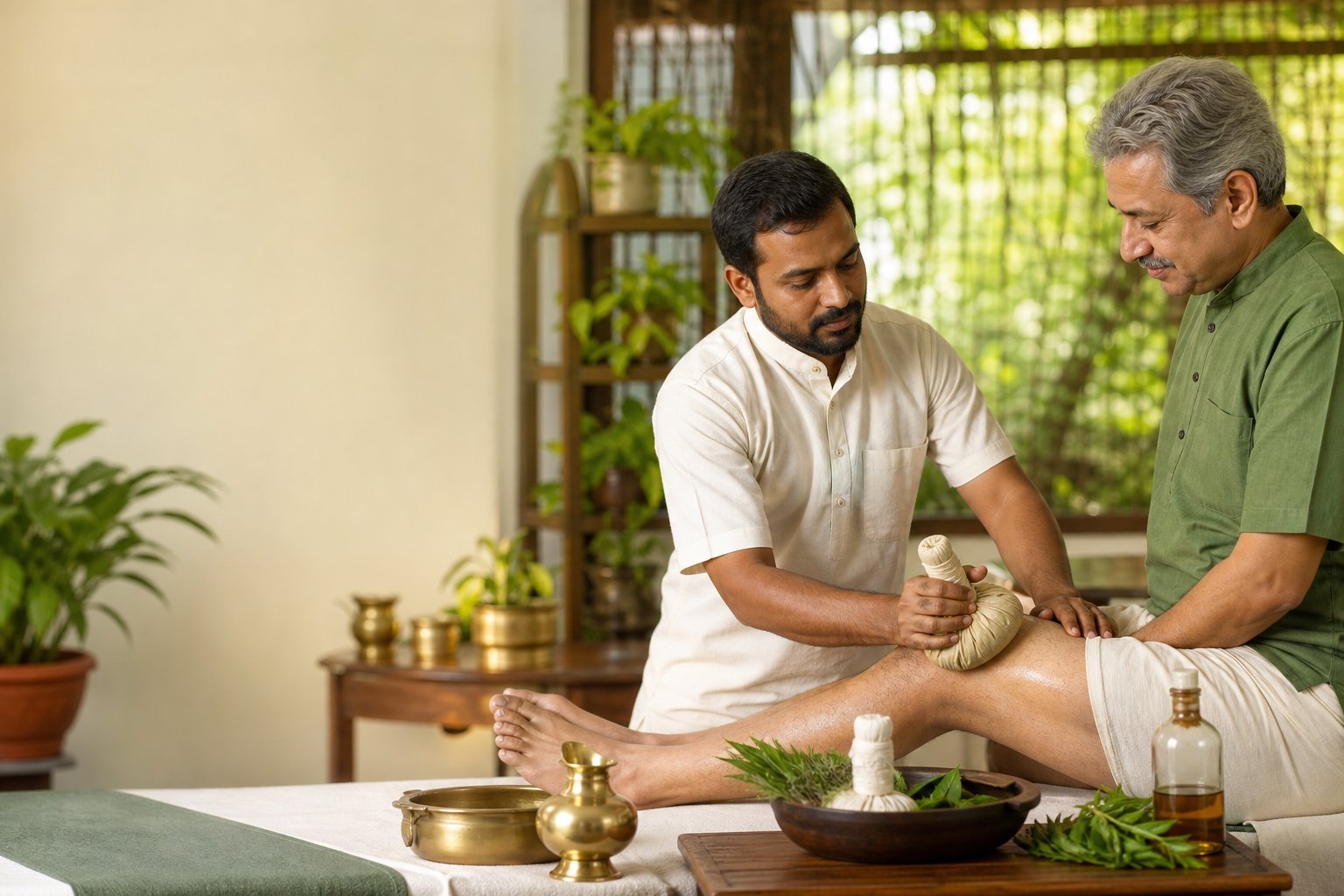
- External applications — medicated oils and Lepa (herbal pastes) that soften scales and calm itching without thinning the skin.
Where stress is a clear driver — and it very often is, since flares chase exams, job pressure and family conflict — we add Shirodhara and simple breathing practices from our Panchakarma programme. Treating the mind is treating the skin.
Diet: What We Actually Ask You to Change
Ayurveda takes food seriously in skin disease, but we keep it practical rather than punishing:
- Reduce very sour, salty, fermented and deep-fried foods — the classic Pitta aggravators
- Avoid the curd-plus-fish type of incompatible combinations (Viruddha Ahara)
- Limit alcohol completely during treatment; it is one of the strongest flare triggers we see
- Some patients report flares with nightshades (tomato, brinjal, chilli); rather than banning them for everyone, we ask you to observe and eliminate only what demonstrably troubles your skin
- Favour warm, freshly cooked food, bitter vegetables, and adequate water
A Realistic Timeline — Months, Not Days
I tell every patient this on day one: psoriasis that took years to establish will not vanish in two weeks, and anyone who promises that is not being honest with you. In our clinical experience, itching and scaling usually begin easing within the first four to six weeks; visible flattening and fading of plaques takes two to four months; and stable, long-lasting remission is a six-month to one-year project including diet and follow-ups. What patients gain is not just clearer skin but skin that stays clear without a cream in the pocket.
When to See a Doctor
Consult a physician promptly — not just for cosmetic reasons — if you notice:
- Patches spreading rapidly or covering large areas of the body
- Joint pain, stiffness or swelling with skin patches (possible psoriatic arthritis — this needs early attention)
- Skin that is red, hot and weeping, with fever
- Cracked, painful palms and soles interfering with work
- Nail pitting, crumbling or lifting
- Sleep loss or low mood because of the skin — this matters as much as the plaques
Not sure whether your patches are psoriasis, eczema or a fungal infection? Start with our symptom checker, then let a doctor confirm the diagnosis in person.
If you are tired of the cream-flare-cream cycle, we would be glad to examine your skin and map out an honest, steroid-free plan. Message us on WhatsApp at +91 94518 46947 or book a consultation at our Jhushi (10 AM–2 PM) or Allahpur (5 PM–9 PM) clinic in Prayagraj.
Frequently Asked Questions
Can psoriasis be cured permanently with Ayurvedic treatment?
Psoriasis is a chronic, relapsing condition, so no ethical doctor — Ayurvedic or allopathic — should promise a lifetime guarantee. What our experience shows is that root-cause treatment with Virechana, Raktamokshana and sustained herbal therapy achieves deep, long-lasting remission in a large proportion of patients, and flares that do occur are milder and easier to settle. Staying flare-free long term depends on continuing the diet and stress practices you learn during treatment.
How long does Ayurvedic treatment for psoriasis take to show results?
Most of our patients notice reduced itching and scaling within four to six weeks, visible clearing over two to four months, and stable remission over six to twelve months. The pace depends on how widespread the disease is, how long you have used strong steroids, and how closely the diet plan is followed. Slow and lasting beats fast and rebounding.
Should I stop my steroid cream before starting Ayurvedic treatment?
Do not stop abruptly on your own — suddenly withdrawing a potent steroid can trigger a severe rebound flare. Bring your creams to the first consultation; we taper them gradually while the internal Ayurvedic treatment takes hold, so your skin is never left unprotected during the transition. This handover phase is planned individually for every patient.