
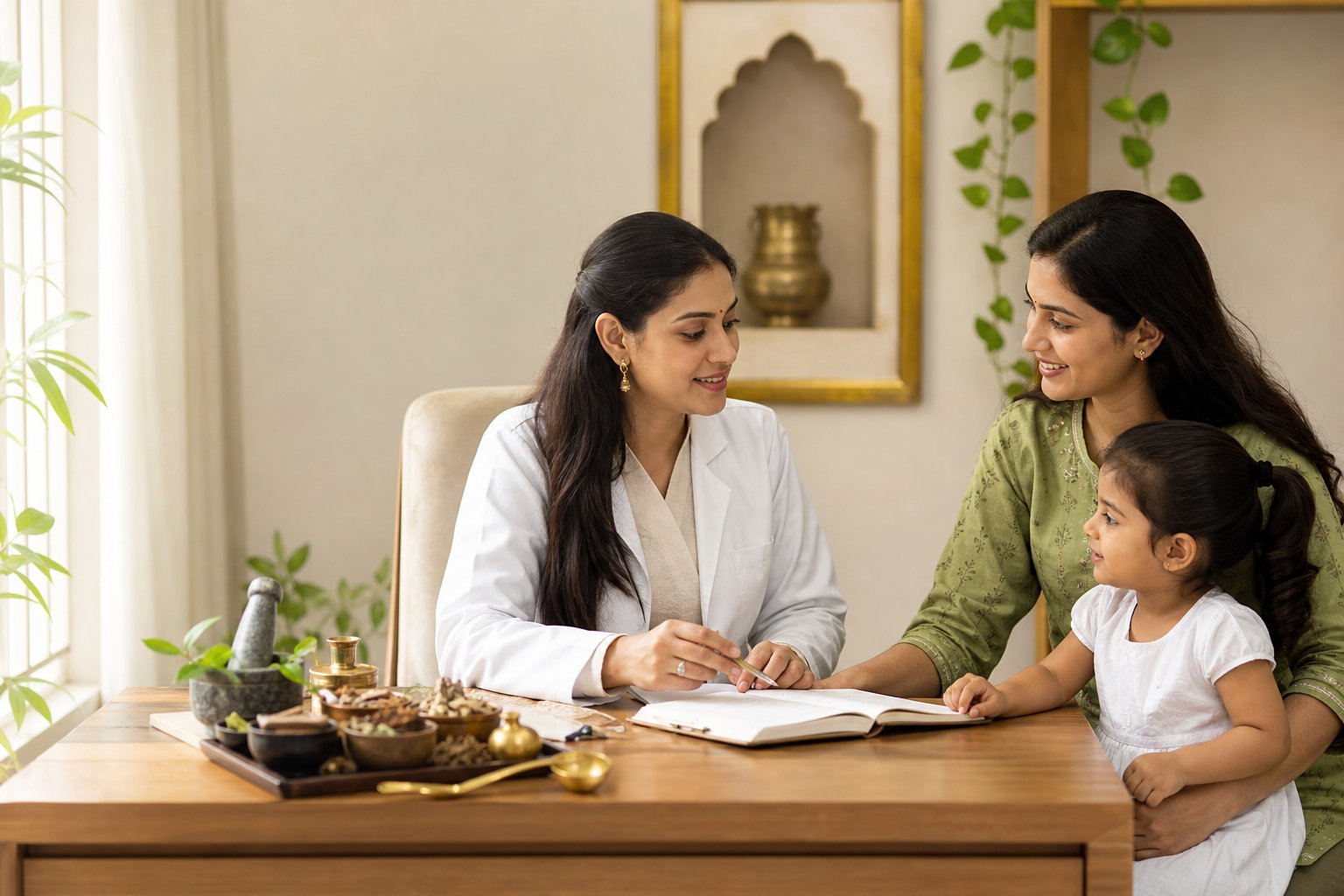
Every few weeks it is the same story: a runny nose becomes a cough, the cough becomes a fever, school is missed, antibiotics are started, and just as your child recovers — it begins again. If you have found yourself searching “bacchon ki immunity kaise badhaye” at midnight while a small feverish head rests on your shoulder, you are far from alone. Recurrent colds, poor appetite and low weight are the most common worries parents bring to my clinic.
One of the answers Ayurveda has offered for centuries is Suvarnprashan (सुवर्णप्राशन), also spelled Swarna Prashan — literally, “the licking of gold.” It is a classical paediatric preparation described in the Kashyap Samhita, Ayurveda’s foundational textbook of child health, and it remains one of the most requested treatments for children at Shree Vishwshraddha Chikitshalaya.
In this article I will explain exactly what Suvarnprashan is, what the tradition and our own clinical experience say it does, how it is dosed — and, just as importantly, what it is not, because I believe parents deserve plain honesty along with ancient wisdom.
What Is Suvarnprashan (Swarna Prashan)?
Suvarnprashan is a drop-based preparation containing:
- Swarna Bhasma: gold that has been purified and processed into an ultra-fine, absorbable form through the classical Shodhana and Marana procedures — not raw metal.
- Cow’s ghee and honey: the traditional carriers that deliver the gold and herbs.
- Medhya (brain-supporting) herbs: typically Brahmi, Shankhpushpi, Vacha and Ashwagandha, chosen for memory, focus and calm.
A few drops are placed on the child’s tongue — that is the entire procedure. No needles, no bitter syrups, no struggle. Most children actually look forward to it.
Why Is It Given on Pushya Nakshatra?
Tradition holds that Suvarnprashan is best administered on Pushya Nakshatra — a specific lunar constellation day that occurs roughly once every 27 days and is considered the most nourishing of all Nakshatras. That is why you will see Ayurvedic clinics across India holding monthly Suvarnprashan camps on this day.
There is also a very practical benefit hidden inside the tradition: it creates a fixed, easy-to-remember monthly schedule, and consistency is what makes any immunity-building programme work. At our clinic we announce the Pushya Nakshatra date each month; children can also be given short daily courses in specific situations, which we decide case by case.
What Benefits Can Parents Expect?
The Kashyap Samhita describes Suvarnprashan as “Medha Agni Bala Vardhanam” — that which enhances intellect, digestion and strength — and credits regular use with better immunity, memory and resistance to illness. In our clinic’s experience with hundreds of children in Prayagraj, the changes parents most consistently report over three to six months of regular doses are:
- Fewer and milder episodes of recurrent cold, cough and seasonal infections
- Improved appetite and steadier weight gain in fussy eaters
- Better concentration, memory and calmer behaviour — often noticed first by teachers
- Better sleep quality
I frame these as traditional use supported by our clinical observation. Large modern trials on Suvarnprashan are still limited, so an honest doctor should not quote laboratory certainty — but centuries of documented use and the month-after-month feedback of parents in our own OPD are why we continue to offer it with confidence.
Age Range and Dosing
Suvarnprashan is given to children from birth up to 16 years — the years in which immunity and the nervous system are actively being built. The dose is small and age-dependent: a single drop for young infants, increasing to a few drops for older children and teenagers. It can be started at any age within this range; there is no penalty for starting “late.” For babies under one year, we adjust the preparation and base appropriately — one more reason this should always come from a doctor rather than a home recipe.
Safety: What Every Parent Must Check
Gold sounds glamorous, but the safety of Suvarnprashan depends entirely on how the Swarna Bhasma was made. Please insist on the following, wherever you take your child:
- Only properly prepared Swarna Bhasma: classical purification, incineration and quality testing. At our clinic we use only tested, pharmacy-grade bhasma.
- Only from a qualified Ayurvedic doctor: not a home preparation, and not the old practice of rubbing a gold ornament of unknown purity on a stone and feeding the paste to an infant.
- Tell the doctor your child’s full history: allergies, ongoing medicines and any chronic condition, so the dose and timing can be personalised.
Given this way, Suvarnprashan has an excellent safety record in traditional practice and in our own clinic — we have not needed to discontinue it for adverse effects in any child under our care.
What Suvarnprashan Is NOT
Let me say this plainly, because your child’s health matters more than any tradition or any clinic’s business: Suvarnprashan is a supplement to good child care, not a replacement for it.
- It does not replace your child’s vaccination schedule. Vaccines protect against specific dangerous diseases; Suvarnprashan does not. Complete every vaccine on time.
- It does not replace balanced daily food, outdoor play and adequate sleep — no drop can outwork a diet of chips and late-night screens.
- It is not an instant remedy for an ongoing infection. A child who is actively ill needs diagnosis and treatment, not just drops.
Think of it the way tradition intended: one steady, monthly investment in a child’s long-term strength, sitting on top of vaccination, nutrition and love — never instead of them.
When to See a Doctor
Immunity-building is for the long run, but some situations need prompt medical attention rather than waiting for the next Pushya Nakshatra:
- Fever lasting more than three days, or any fever in a baby under three months
- Fast or difficult breathing, chest indrawing, or wheezing
- A child who is unusually drowsy, refusing feeds, or not passing urine normally
- Poor weight gain or weight loss over several months
- Infections severe enough to need antibiotics again and again — this pattern deserves a proper work-up, not just another syrup
If your child falls sick too often, or you would like to join our monthly Suvarnprashan schedule, message us on WhatsApp at +91 94518 46947 or book a visit — Jhushi clinic runs 10 AM–2 PM every day and Allahpur 5 PM–9 PM, Monday to Saturday. You can also run your child’s symptoms through our symptom checker first if you are unsure whether a visit is needed.
Frequently Asked Questions
At what age can Suvarnprashan be started, and until what age is it given?
It can be started any time from birth up to 16 years of age, and is traditionally continued until 16. Starting early gives the longest benefit, but children who begin at five, eight or twelve years still benefit — in our experience the improvement in recurrent infections is visible within three to six months of regular monthly doses at any starting age.
Does Suvarnprashan have to be given only on Pushya Nakshatra?
Pushya Nakshatra is the traditionally preferred day, and the monthly rhythm it creates is genuinely useful for consistency. However, classical practice also allows daily short courses in particular situations. If you miss the Nakshatra date, do not abandon the month — speak to your Ayurvedic doctor and adjust rather than skip.
Can Suvarnprashan replace vaccination for my child?
No — and any practitioner who tells you otherwise is putting your child at risk. Vaccines protect against specific life-threatening diseases like measles, diphtheria and polio; Suvarnprashan is a general strength-and-immunity tonic from the Ayurvedic tradition. At our clinic we insist that every child’s vaccination schedule stays complete and on time, with Suvarnprashan working alongside it, never in place of it.