
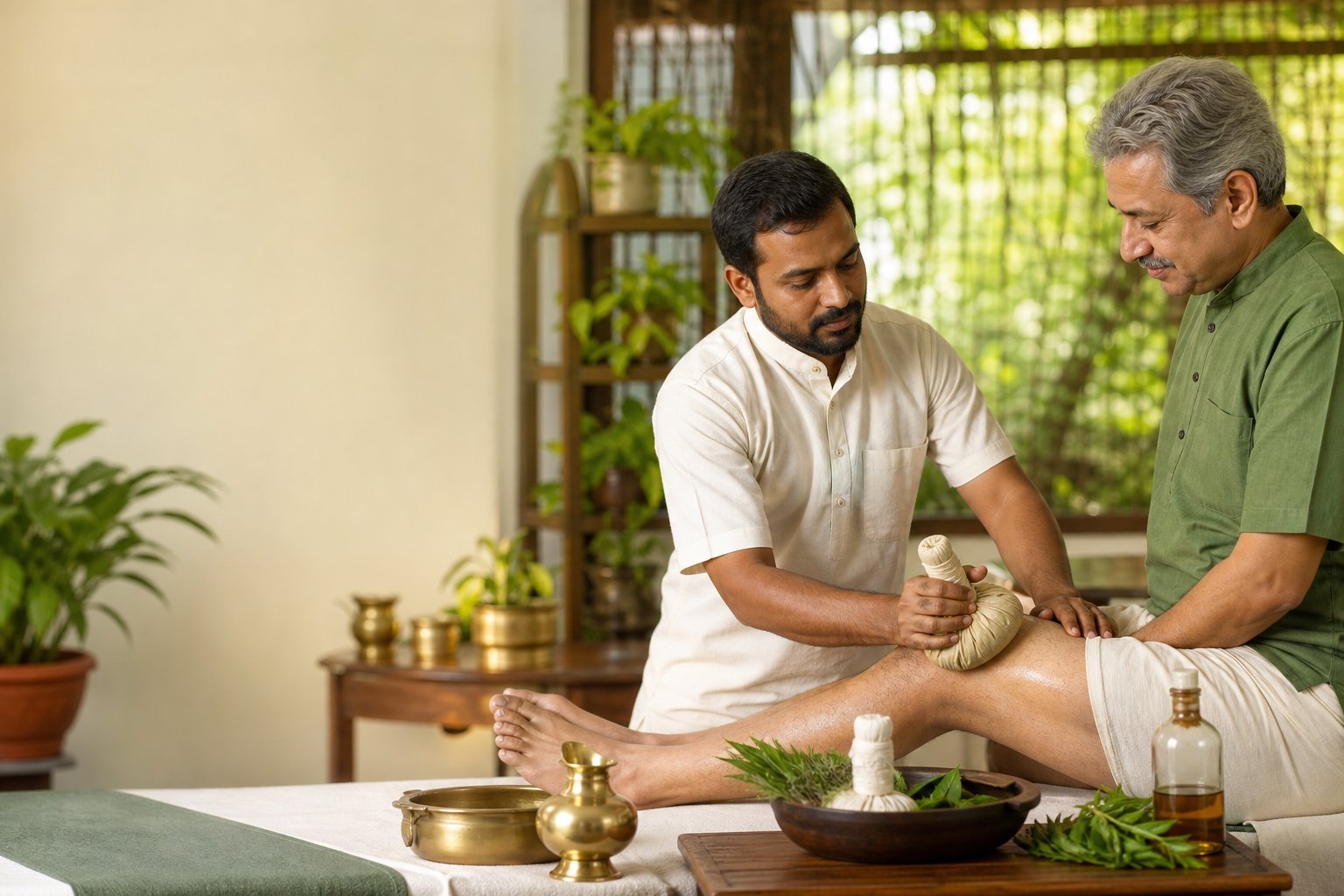
It usually starts small. A twinge while climbing the temple stairs. A stiff, creaky feeling when you stand up after sitting cross-legged. Then one winter it becomes a daily companion — knees that ache at night, that crackle on the stairs, that make you plan your day around how much walking it involves. Ghutno ka dard (घुटनों का दर्द) is one of the commonest complaints in our OPD, and by the time patients reach us, many have already been told the sentence they fear most: “You will eventually need a knee replacement.”
For some advanced cases, that advice is correct — and I will be honest with you about exactly when. But a very large number of knees we see are nowhere near that stage. They are painful because the joint is dry, inflamed and undernourished — and Ayurveda has a beautifully direct therapy for exactly this problem, practised for centuries: Janu Basti (जानु बस्ती).
What Exactly Is Janu Basti?
“Janu” means knee and “Basti” here means a container or reservoir. In this therapy, we build a small dam of black-gram (urad) flour dough around your knee joint while you lie comfortably on the treatment table. Into this well we slowly pour warm medicated oil — chosen for your condition, commonly preparations like Mahanarayana or Dhanwantharam taila — and keep it pooled over the joint for 25 to 40 minutes, gently rewarming it so the temperature stays steady.
In Ayurvedic terms, osteoarthritis (Sandhigata Vata) is a disease of aggravated Vata drying up the joint’s lubrication (Shleshaka Kapha) and wearing down its tissue. Janu Basti reverses that direction of travel: sustained warm oleation calms Vata, softens stiff structures, improves local circulation and nourishes the cartilage, ligaments and muscles around the joint. Think of it as deep, prolonged oiling of a hinge that has been running dry for years.
What a Session Feels Like
Patients are often nervous before the first sitting and sleepy by the third. A typical session at our clinic goes like this:
- You lie on your back with the knee exposed; the therapist builds the dough ring around the joint and checks it is leak-proof.
- Warm — never hot — medicated oil is poured in gradually. Most patients describe the first few minutes as a spreading, pleasant warmth deep inside the joint.
- The oil is kept at an even temperature for 25–40 minutes, being replaced as it cools. Many patients doze off.
- The oil and dough are removed, the knee is gently massaged, and mild herbal fomentation (Swedana) may follow.
There are no injections, no incisions and no downtime — you walk in and walk out, usually feeling looser than when you came. By the fourth or fifth sitting, most patients report noticeably easier stair-climbing and less morning stiffness; by the end of a course, better sleep and longer pain-free walking distance are the changes people mention first.
Which Knee Problems Respond — and Which Need More
Being selective is what makes results honest. In our experience, Janu Basti works best for:
- Early to moderate osteoarthritis — pain, crepitus (crackling), stiffness, difficulty with stairs and sitting on the floor
- Dryness and stiffness after age 45–50, especially where reports show reduced joint space but reasonable cartilage remaining
- Post-injury stiffness and chronic strain in people who stand or walk long hours
- Early knee involvement in other joint conditions, alongside systemic treatment
And where I will be straightforward with you: in advanced, bone-on-bone arthritis with severe deformity — knees that have bowed outward, cartilage fully lost, X-ray showing bone grinding on bone — Janu Basti alone will not regrow what is gone. Even there it often reduces pain and improves function meaningfully, and for elderly patients unfit for surgery it can be a genuine mercy. But if a surgeon has shown you a truly end-stage joint, we will tell you honestly whether Ayurveda can still delay or avoid the operation in your case, or whether replacement is the right path. Our goal is your walking comfort, not winning an argument between systems.
The Typical Course at Our Clinic
A standard course of Janu Basti for arthritis at Shree Vishwshraddha Chikitshalaya runs 7 to 14 consecutive sittings, each taking under an hour, as a simple day-care visit — mornings at Jhushi (10 AM–2 PM) or evenings at Allahpur (5 PM–9 PM). Chronic knees often benefit from a repeat course after three to six months, and we reassess your progress rather than prescribing repetition by habit.
What We Combine It With
Janu Basti is the local therapy; lasting results come from treating the whole system that produced the arthritic knee:
- Basti (medicated enema) — the classical master treatment for Vata disorders, nourishing all joints from within; part of our Panchakarma programme
- Internal herbs — formulations built around Shallaki, Guggulu, Ashwagandha and Rasna to reduce inflammation and support cartilage
- Weight management — every extra kilogram of body weight loads the knee several times over while walking; even modest weight loss visibly changes pain scores, and we plan diet accordingly
- Simple home care — quadriceps-strengthening exercises, warm oil application, avoiding prolonged squatting and cross-legged sitting during flare-ups
When to See a Doctor
Do not sit at home with painkillers if you notice any of these — get the knee examined promptly:
- A hot, red, swollen knee with fever — possible infection, which is an emergency
- Knee pain after a fall or twist with inability to bear weight
- The knee locking, giving way or buckling suddenly
- Night pain severe enough to wake you regularly
- Rapidly progressing deformity or one leg visibly bending outward
- Needing painkillers daily just to move around the house
If you are unsure how serious your symptoms are, our symptom checker can help you decide your next step.
If your knees are stealing your stairs, your walks or your sleep, come and let us examine them before you accept surgery as the only road. Message us on WhatsApp at +91 94518 46947 or book a consultation — bring your X-ray or MRI reports if you have them, and we will give you a clear, honest plan.
Frequently Asked Questions
How many sittings of Janu Basti are needed for knee pain?
Most patients need 7 to 14 consecutive daily sittings, each lasting under an hour. Mild, early stiffness may settle within a single 7-day course, while long-standing osteoarthritis typically takes the full 14 days plus internal medicines, with a repeat course after a few months if needed. Improvement usually becomes noticeable between the fourth and seventh sitting.
Can Janu Basti really help me avoid knee replacement?
In early to moderate osteoarthritis — which is when most people are first warned about future surgery — our experience is that a proper course of Janu Basti with Basti therapy, herbs and weight management relieves pain and restores enough function that many patients postpone or never need the operation. In truly end-stage, bone-on-bone knees we are honest that therapy can ease symptoms but cannot rebuild lost cartilage, and we will tell you plainly which category your reports show.
Is Janu Basti painful or safe for elderly patients?
It is one of the gentlest therapies in Ayurveda — no needles, no cuts, only warm oil pooled over the knee. Most elderly patients find it deeply relaxing and many fall asleep during sessions. Because it is non-invasive and day-care, it is especially suitable for older patients with diabetes or heart conditions who are poor candidates for surgery, though we always review your overall health before starting.