
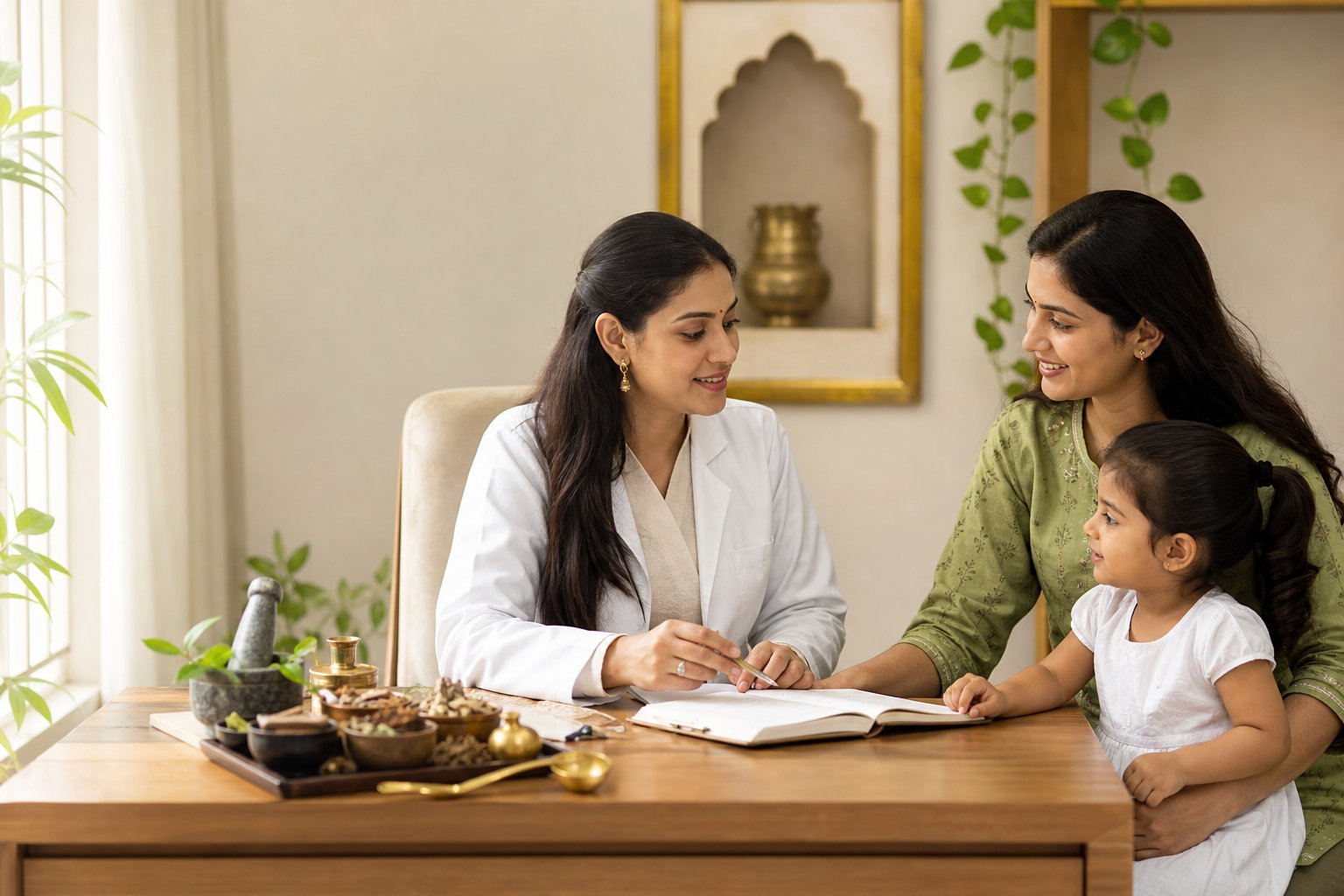
Every month brings the same quiet heartbreak. The test is negative again. Relatives have started asking questions at every gathering. Someone has mentioned IVF, and the numbers you found online — one to three lakh rupees per cycle, with no guarantee — kept you awake all night. If this is where you are, please know that you are not late, you are not broken, and there is a thoughtful middle path worth understanding before you jump to the most invasive option.
That path is Garbha Sanskar (गर्भ संस्कार) — Ayurveda’s structured programme for preparing a couple for conception and then supporting the pregnancy month by month. It is far more than playing music to a baby bump, which is the popular caricature. Done properly, it is a medical preconception protocol with a clear logic: prepare the seed, prepare the soil, and then nurture what grows.
At Shree Vishwshraddha Chikitshalaya in Prayagraj, this programme has helped more than 200 couples in our care conceive naturally — many of whom had been told IVF was their only option. Here is what it actually involves, and — just as importantly — when I honestly tell couples that IVF is the right road for them.
What Is Garbha Sanskar, Really?
Classical Ayurveda compares conception to farming: you need a healthy seed (Beeja — the egg and the sperm), a fertile field (Kshetra — the uterus), the right season (Ritu — ovulation timing) and nourishment (Rasa). Garbha Sanskar systematically works on all four. The programme has four practical pillars:
- Shodhana (purification): supervised Panchakarma detoxification for both partners to clear accumulated metabolic waste before conception — the Ayurvedic equivalent of preparing the field before sowing.
- Vrishya Chikitsa (reproductive strengthening): classical herbs and Rasayana formulations that improve egg quality, sperm count and motility, and uterine health.
- Ahara and Vihara (diet and routine): a food and daily-routine plan for the fertile months and then for each month of pregnancy.
- Mind practices: mantra, prayer or simple guided calm — presented practically, because chronic stress demonstrably disturbs ovulation and sperm production. Whether you approach these spiritually or simply as daily stress medicine, they earn their place.
Fertility Is a Couple’s Project, Not a Woman’s Burden
In our society the woman is questioned first, but medicine tells a different story: male factors contribute in roughly 40–50 percent of couples who struggle to conceive. Sperm takes about 72–90 days to form, which means a husband’s diet, sleep, smoking, alcohol and stress in the three months before conception directly shape it. This is why in our clinic both partners are assessed and both receive Vrishya Chikitsa — treating only one half of the equation wastes precious time.
For the wife, we look at ovulation, cycle regularity and uterine health. Where indicated — for example with PCOS (see our PCOS protocol), blocked energy in the reproductive channels or a thin uterine lining — Uttarbasti, a targeted procedure delivering medicated ghee or oil through the uterine route, is added.
When Ayurveda Is a Sensible First Step — and When IVF Is Right
I owe every couple honesty here. Ayurveda is a sensible first choice when the problem is functional: unexplained infertility with normal reports, PCOS and irregular ovulation, mild to moderate sperm abnormalities, thin endometrium, repeated early miscarriage, or simply fewer than two to three years of trying in a younger couple. These are exactly the situations where our 200+ natural conceptions have come from.
But Ayurveda cannot open two completely blocked fallopian tubes, produce sperm where there is none (azoospermia), or turn back the clock on a very low ovarian reserve at an advanced age. In such cases I say so plainly at the first consultation and refer the couple for IVF without wasting their money or their most valuable asset — time. Even then, many couples use our preparation protocol alongside IVF, and in our experience a well-prepared body responds better to any fertility treatment, natural or assisted.
The Programme, Month by Month
- Month 1 — Assessment and Shodhana: detailed history, reports for both partners, Prakriti analysis, then Panchakarma cleansing tailored to each person.
- Months 2–3 — Building phase: Vrishya Chikitsa herbs for both partners, Uttarbasti for the wife if indicated, diet correction, sleep and stress routines. This mirrors the 90-day egg and sperm maturation window.
- Months 3–6 — Conception window: ovulation tracking and fertile-timing guidance while the medicines continue. Most of our natural conceptions happen in this phase.
- After conception — Masanumasik care: month-wise pregnancy support. Patients often ask “pregnancy me kya khana chahiye?” — Ayurveda answers month by month: light, sweet, easily digested foods and milk in the early months when nausea rules; ghee, protein-rich dals and seasonal fruit as the baby builds tissue in the middle months; and specific preparations in the final weeks to support a smooth delivery. Alongside food, we guide gentle routine, safe movement and daily calming practice for the mother.
What You Can Do Starting Tonight
- Both partners: fix your sleep — in bed by 11 PM.
- Cut alcohol and tobacco completely; both measurably damage egg and sperm quality.
- Eat home-cooked food at regular times; add soaked almonds, seasonal fruit, milk with a pinch of turmeric if it suits you, and a spoon of pure ghee.
- Walk together for 30–40 minutes daily — it helps hormones and the marriage.
- Stop calculating and quarrelling over fertile days without data; proper ovulation tracking removes the guesswork and half the stress.
When to See a Doctor
Seek a proper fertility evaluation — not just reassurance — if:
- You have been trying for over a year, or over six months if the wife is 35 or older
- Periods are absent, very irregular or extremely painful
- There have been two or more miscarriages
- The husband has a history of mumps in adulthood, varicocele, or an abnormal semen report
- Either partner has thyroid disease or diabetes that is not well controlled
If you are ready to try a structured, honest approach before — or alongside — assisted reproduction, message us on WhatsApp at +91 94518 46947 or visit our fertility and Garbha Sanskar page. I consult at Jhushi (10 AM–2 PM, all days) and Allahpur (5 PM–9 PM, Mon–Sat), and both partners are welcome at the first visit.
Frequently Asked Questions
Does Garbha Sanskar really help you conceive naturally without IVF?
In our clinic’s experience — over 200 couples and counting — yes, provided the underlying problem is functional: irregular ovulation, PCOS, mild sperm abnormalities, unexplained infertility. It is not a substitute for IVF where there is an absolute barrier such as both tubes blocked or zero sperm count; we tell couples this honestly at the first consultation.
When should we start Garbha Sanskar — how many months before pregnancy?
Ideally three to six months before you plan to conceive. Eggs and sperm take roughly 90 days to mature, so the detox and strengthening phases need that runway to influence their quality. Couples who have already been trying for a while can start immediately; the programme adjusts to where you are.
Is Uttarbasti painful, and is it safe?
Uttarbasti is performed by a trained doctor under aseptic conditions, usually just after the period ends. Most women describe mild cramping rather than pain, and it is done as a short outpatient procedure over a few consecutive days. We only recommend it where the assessment shows it will genuinely help — it is not a routine add-on for every patient.